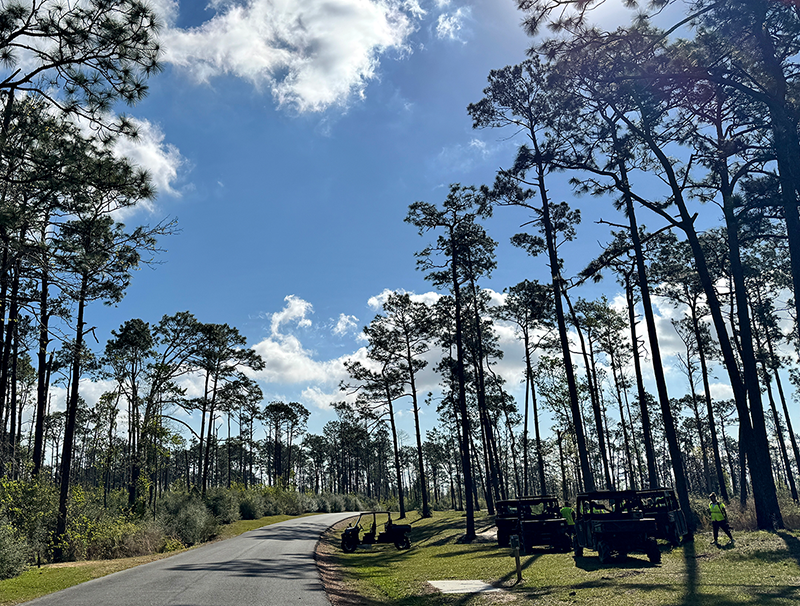
When a hurricane passes through a forest, the damage is easy to see. Thousands of downed trees, broken canopies, and closed park roads are visible reminders of the storm's power. What is less obvious is what happens in the years that follow. Without active management, invasive species, dense woody vegetation, and the loss of natural ecological processes can prevent a forest from recovering to its historic condition.
That challenge is driving one of Louisiana's largest state park restoration efforts at Sam Houston Jones State Park. Located in Calcasieu Parish about 10 miles north of Lake Charles, the park is undergoing a six-year ecological restoration designed to strengthen resilience, restore native habitats, and support biodiversity across Southwest Louisiana's only state park.
The work demonstrates that successful ecological restoration is about much more than replacing what was lost. It requires rebuilding the ecological processes that allow a landscape to sustain itself over time.

Five habitats, five restoration strategies
While the project shares an overall objective of improving ecological resilience, each habitat requires a different restoration approach.
The cypress tupelo swamp remains one of the park's healthiest ecosystems, but gaps in the canopy and invasive species have begun affecting natural regeneration. Restoration focuses on invasive species removal and supplemental cypress planting to strengthen long-term forest structure.
Within the degraded bottomland hardwood forests, mature trees remain, but dense midstory growth has overtaken much of the understory. Selective mulching and native hardwood planting will help restore a more balanced forest structure and improve habitat for wildlife.
READ NEXT> It's all about the water: How restoring hydrology at Riverby Ranch brought a Texas landscape back to life StoryMap
Longleaf pine savannas require a different strategy. These fire-adapted ecosystems depend on open canopies and diverse understories maintained through regular fire. Restoration includes removing encroaching woody vegetation, planting additional longleaf pine, and reintroducing prescribed fire to maintain the conditions needed for native grasses and forbs to thrive.
The park also contains sensitive bog systems surrounded by longleaf pine habitat. These areas support specialized plant species, including sundews and sphagnum moss, that depend on specific environmental conditions. Restoration reduces woody encroachment in surrounding uplands while protecting the bogs during prescribed burning operations.
WATCH NEXT> Restoring nature's fish habitats: Nicholls State University studies marsh terraces
Bayhead swamps present another unique challenge. Because these wetlands are sensitive to fire while adjacent pine savannas depend on it, restoration includes installation of firebreaks that protect bayhead habitats while allowing prescribed fire to continue in neighboring uplands.
In low-lying portions of the rivercane habitat, restoration will reestablish rivercane, a native plant community that has declined significantly throughout the region. Restoring rivercane increases habitat diversity while helping rebuild a more complete longleaf pine ecosystem.
WATCH NEXT> Supporting Brown Pelican habitat through the restoration of Rabbit Island



_2_1.jpg)