What Is RES' Innovation Leadership Program?
The RES Innovation Leadership Program, or ILP, is an internal research and development grant program that funds focused ideas with the potential to improve project delivery, strengthen technical methods, reduce risk, or produce better ecological outcomes.
The program was co-founded by Bob Siegfried II and Matt Stahman to create a path to improve project delivery, strengthen technical methods, reduce risk, and advance restoration practice.
Scientists, engineers, planners, GIS specialists, operations staff, and other RES professionals can propose projects that address a practical challenge and have the potential to create a repeatable method, tool, dataset, or technical capability.
RES is entering its 7th year of investment in the program, creating room to test questions that may not fit within a single client assignment but could ultimately improve outcomes across many projects.
We spoke with Bob about why ILP was created, how research becomes a usable project capability, and where employee-led innovation could go next.
What prompted RES to create the Innovation Leadership Program?
We looked at how other companies created formal space for research and development. The lesson was that useful innovation rarely happens by accident; organizations need a structure that allows good ideas to be tested.
We also studied programs within the environmental field to understand how that model could translate to the practical, multidisciplinary work RES performs.
The ILP became RES' internal research and development program. Ideas can come from science, engineering, GIS, monitoring, construction practices, or another technical area, but they need a clear connection to a real project challenge.
The program provides enough time and funding to determine whether an idea can become a useful, repeatable capability rather than remaining an informal concept.
Why was it important for RES to create that opportunity?
There are three main reasons.
First, an ILP project should have the potential to improve project delivery. It may help teams work more efficiently, reduce risk, strengthen monitoring, or produce better ecological results. The research must connect to the work RES performs.
Second, the program creates room for subject-matter experts to investigate questions that a client's schedule may not allow them to explore, even when the answer could improve future projects.
That turns specialized expertise in areas such as pollinators, soil biology, or environmental DNA into knowledge that can be tested and applied more broadly.
Third, sharing technically rigorous results helps clients, regulators, and project partners understand why a new method is credible and where it can improve outcomes. It also contributes useful evidence to the broader restoration industry.
How has the program affected the way RES approaches innovation?
The development of environmental DNA (eDNA) capabilities is probably the clearest example.
When the first eDNA proposal came through the ILP, the technology was new to many people at RES. The proposal began with a practical question: how could eDNA improve restoration monitoring?
READ NEXT> RES eDNA and Innovation Leadership program
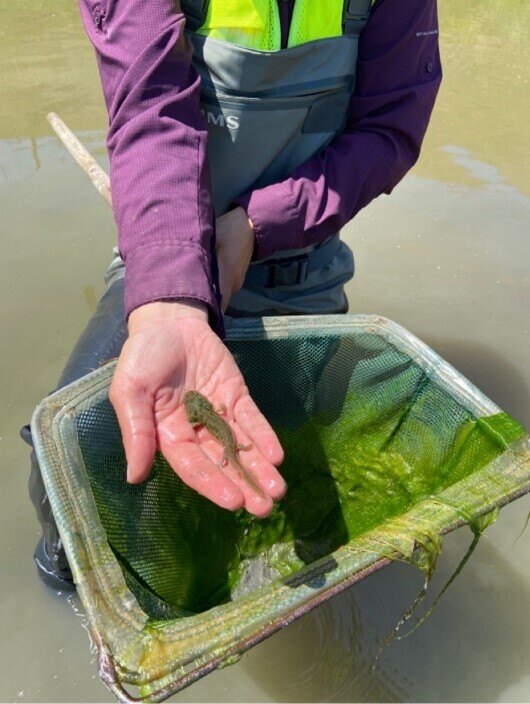
Through several ILP grants, the team tested the approach, documented repeatable procedures, and trained teams in multiple regions.
Initially, we were primarily looking to use eDNA to study fish on the West Coast. Now teams are applying it to bats in the Midwest, aquatic insects in the East, and other monitoring questions across the company.
In Georgia, for example, eDNA helped document the recovery of benthic insect communities following restoration. Regulators were interested in how traditional sampling and eDNA could complement one another and provide a more complete picture of what was happening at the site.
That is the model we hope an ILP project can follow: begin with a focused question, demonstrate value, and become a capability that can be used on real projects.
Why do you think the eDNA work spread so successfully?
It had a champion who was both an expert in the technology and committed to teaching other people how to use it.
A useful idea does not become a scalable capability through a report alone. Teams need clear procedures, training, and opportunities to apply the method themselves.
The eDNA work paired technical documentation with hands-on training in different regions. That combination turned specialized expertise into a repeatable capability and helped project teams identify new applications.
We are now using it to answer practical questions, including whether fish are moving through a former dam site after removal. It is no longer only a research exercise. It has become another tool available to our project teams.
Was there another ILP project that stood out to you?
I also really liked the pollinator study conducted with the University of Richmond.
READ NEXT> From degraded stream to pollinator habitat: Little Westham Creek
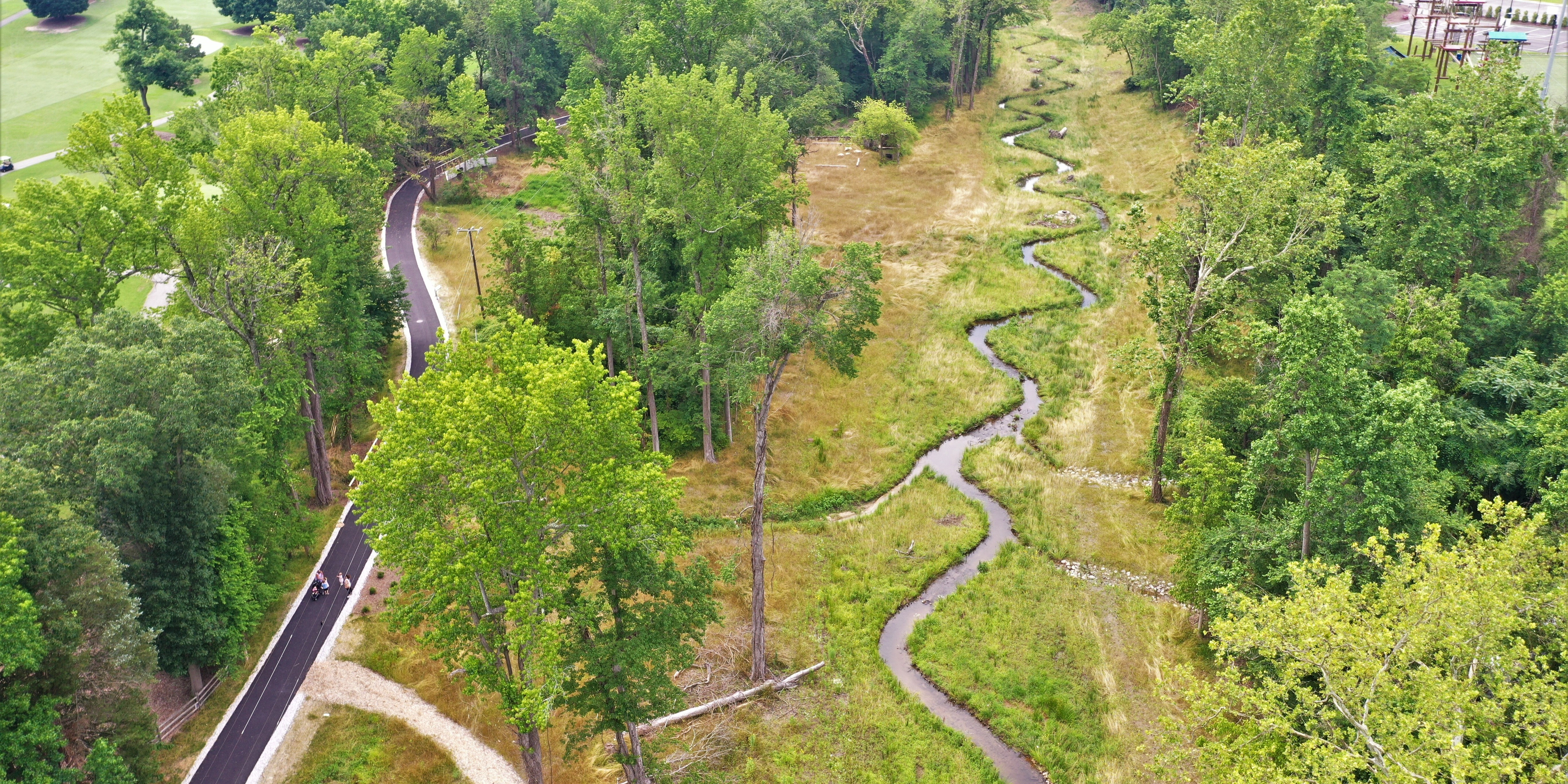
Stream restoration is not only about what happens inside the stream channel. The surrounding floodplain and buffer are also important. During restoration, trees may be removed, and new vegetation begins to establish. That transition can lead to questions about the temporary loss of forested cover.
The study helped demonstrate that temporarily unforested stream buffers can still provide meaningful ecological value, including habitat for pollinators, while the longer-term riparian forest becomes established.
That gives us a better way to explain what is happening at a restoration site. It can help address public or agency concerns while also expanding how we evaluate the benefits of stream restoration.
The findings also gave teams clearer evidence for explaining temporary site conditions and long-term ecological value to clients, agencies, and the public.
How does RES decide which projects to fund?
The ILP supports focused research and development with a clear connection to project delivery or restoration practice. A proposal should have the potential to produce a better method, tool, dataset, or technical capability rather than simply support routine project work.
The strongest proposals begin with a specific, well-defined question and a clear plan for how the results could be tested, shared, and applied.
Broad ideas are often narrowed to enable the team to produce a credible result and determine whether the approach merits further investment.
Teams can then build on a successful first phase. That is how the eDNA work developed: the team proved individual applications over time rather than trying to address every potential use in the first year.
Innovation also involves uncertainty. Some ideas perform as expected; others need to change direction based on the evidence. Testing at a focused scale helps reveal what works before a method is adopted more broadly.
That learning is part of the value: it can prevent larger investments in an approach that is not ready, while identifying promising methods that deserve to be scaled.
What kinds of questions do you think future ILP projects will need to address?
One major opportunity is to figure out how to use artificial intelligence responsibly in our work.
RES collects large volumes of project and monitoring data. In one ILP-supported wildlife study, technology helped sort through more than 400,000 game-camera images and identify those that contained animals.
READ NEXT> What 400,000 trail camera images taught us about solar development and grassland birds
The larger opportunity is to learn more from the information RES already collects.
Restoration results are often evaluated on a project-by-project basis. Looking across larger datasets could reveal patterns that are difficult to see at a single site.
Those patterns could improve design, monitoring, construction, or long-term performance. AI may help identify them, but using it responsibly and accurately will require careful testing.
How do you see the ILP fitting into the broader future of innovation at RES?
We have always viewed innovation as a pathway, not a single grant.
The ILP provides the initial funding to investigate a focused idea.
Successful projects may then produce technical publications, standards, training materials, or other resources that make the findings useful beyond the original research team.
Some may also lead to proprietary methods, processes, or tools that give project teams a new way to solve a recurring challenge.
Not every project will follow the same path, but the goal is consistent: connect a promising idea to tested knowledge, practical use, and, where appropriate, broader industry value.
What lessons have you learned after seven rounds of the program?
The biggest lesson is to keep projects focused. A clearly defined question is easier to test and more likely to produce results that other teams can use.
We have also learned that strong ideas often improve through collaboration and iteration. Connecting teams working on similar questions can reduce duplication and produce findings that apply across more regions or project types.
Giving a team room to refine the question, narrow the scope, or build on earlier work increases the likelihood that the research will lead to a useful method or capability.
The goal is not simply to fund interesting research. It is to develop ideas that can improve project delivery, reduce risk, or strengthen ecological outcomes.
Interested in learning more? Connect with us to see how our innovations can be applied to your next project.
- Environmental Mitigation (50)
- Video (48)
- Article (42)
- Natural Resource Restoration (37)
- Landscape-scale Restoration (36)
- Species & Habitats (31)
- Water Quality (25)
- Resiliency (22)
- Texas (17)
- Virginia (16)
- California (15)
- Pennsylvania (15)
- Nature-based Solutions (13)
- Technology & Innovation (13)
- Water Quantity (13)
- Regulatory (12)
- Large-scale Development (11)
- Klamath (10)
- Research (10)
- Louisiana (9)
- Oregon (9)
- Procurement (9)
- Storymap (9)
- Data Centers (7)
- Corporate Sustainability (6)
- Ecological Site Solutions (6)
- Florida (6)
- Presentation (6)
- Volumetric Water Benefits (6)
- Case Studies (5)
- Jon Kasitz (5)
- Water Stewardship (5)
- Bob Siegfried (4)
- Coastal Resiliency (4)
- Maryland (4)
- Urban Renewal (4)
- Dam Removal (3)
- Mary Szafraniec (3)
- North Carolina (3)
- Stormwater Management (3)
- Studies & Reports (3)
- Bailey Wilfong (2)
- Bois Darc (2)
- Dylan Keel (2)
- Economic Development (2)
- Environmental Restoration (2)
- Federal (2)
- Flooding (2)
- Georgia (2)
- Illinois (2)
- Indiana (2)
- Innovation Leadership Program (2)
- Justin Freedman (2)
- Matt Stahman (2)
- Milwaukee (2)
- Mine Reclamation (2)
- Mitigation credits (2)
- Podcast Audio (2)
- South Carolina (2)
- Stewardship (2)
- Tennessee (2)
- Webinar (2)
- Whitepaper (2)
- Wisconsin (2)
- Advisory (1)
- Alabama (1)
- Brandon Hall (1)
- Caitlin Burke (1)
- Carpentersville Dam (1)
- Conservation Bank (1)
- Desmond Duke (1)
- Joe Volpe (1)
- Kathy Hoverman (1)
- Larsen McBride (1)
- Michigan (1)
- New York (1)
- North Dakota (1)
- Ohio (1)
- Patrick Daniels (1)
- Paul Braun (1)
- Robin Bedenbaugh (1)
- Solar (1)
- Suburban Chicago (1)
- Tree Planting (1)
- Trey Shaffer (1)
- Wesley Hayes (1)
- West Virginia (1)
- September 2026 (4)
- August 2026 (6)
- July 2026 (5)
- June 2026 (3)
- May 2026 (2)
- April 2026 (4)
- March 2026 (1)
- February 2026 (3)
- January 2026 (2)
- December 2025 (1)
- November 2025 (1)
- September 2025 (2)
- August 2025 (3)
- June 2025 (1)
- May 2025 (3)
- March 2025 (3)
- February 2025 (2)
- January 2025 (20)
- December 2024 (10)
- November 2024 (31)
- October 2024 (7)
- August 2024 (2)
Subscribe to RES
Share this post